How to Read Nutrition Labels: 2026 Guide
Key Takeaways
Nutrition labels have undergone a massive transformation in 2026. From the new Front-of-Package (FOP) 'Nutrition Info Box' to stricter 'Healthy' claims, this guide covers everything you need to know to spot ultra-processed foods and make smarter grocery choices.
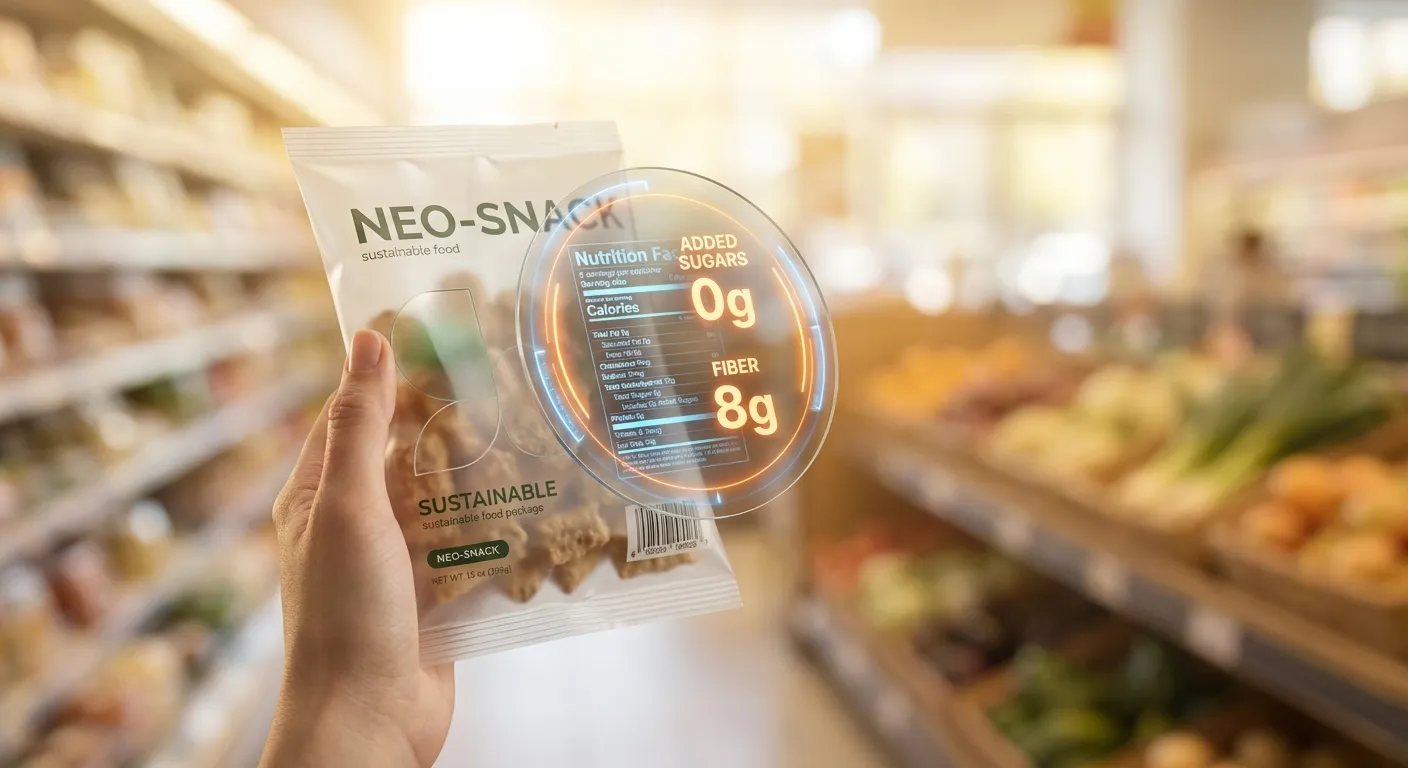
Grocery shopping in 2026 feels less like a chore and more like navigating a minefield. With over 40,000 items in the average supermarket and thousands of new products launching every year, the "Health Halo" marketing effect is stronger than ever. Bright colors, bold claims like "Keto-Friendly," "Plant-Based," and "Immunity Boosting" scream for your attention.
But here is the truth: The front of the box is marketing. The back of the box is math.
Thanks to new FDA regulations implemented fully in 2026, we have better tools than ever to decode what's really in our food. But you need to know how to use them. If you're still just looking at calories, you're playing a game from 1990.
This is your ultimate masterclass on reading nutrition labels in 2026. We will cover the new Front-of-Package rules, the hidden names of sugar, the "Net Carb" trap, and how to spot Ultra-Processed Foods (UPF) that no label will explicitly warn you about.
The Short Answer: The 30-Second Scan Strategy
If you are in a rush and only have 30 seconds to judge a product, ignore the claims and check these three critical data points:
- The Front-of-Package (FOP) Warning: Look for the new "Nutrition Info Box". Is it marked "High" in Added Sugars or Sodium? If yes, put it back.
- The First 3 Ingredients: Do they sound like real food (e.g., "Rolled Oats, Almonds, Honey") or a chemistry set (e.g., "Soy Protein Isolate, Maltodextrin, High Fructose Corn Syrup")? The first three ingredients make up the bulk of what you are eating.
- The "Added Sugars" Line: Don't look at total sugar. Look at Added Sugars. If it's more than 5g per serving, it's a dessert, not a snack.
1. The New Front-of-Package (FOP) Labels: A Game Changer
The biggest change in the 2026 food landscape is the widespread adoption of the FDA's Front-of-Package Nutrition Labeling. For decades, the US lagged behind countries like Chile and Mexico, which used "Stop Sign" warnings. Now, we have our own system.
The "Nutrition Info Box" Explained
You will now see a standardized box on the front of most packaged foods. It gives you an "at-a-glance" rating for three critical nutrients linked to chronic diseases like diabetes and hypertension:
- Added Sugars
- Saturated Fat
- Sodium
Each nutrient is categorized as High, Medium, or Low based on the % Daily Value (%DV).
- Why this matters: Previously, you had to turn the package over, find the serving size, and do mental math. Now, if a "Healthy" looking granola bar has a "High" warning for Added Sugars, you know instantly it's basically a candy bar.
- The Strategy: Make it a rule to avoid daily staples (bread, yogurt, cereal) that carry a "High" warning in any category.
2. The "Healthy" Claim: Finally Meaningful?
For years, sugary cereals could slap a "Healthy" label on their box just because they were low in fat and fortified with Vitamin C. It was a loophole that misled millions. In 2026, that loophole has been closed.
The FDA's updated definition of the implied nutrient content claim "Healthy" is now rigorous. To use this word, a food must:
- Contain Real Food: It must contain a meaningful amount of food from at least one of the recommended food groups (fruit, vegetable, dairy, whole grain).
- Adhere to Strict Limits: It must be below specific thresholds for added sugars, saturated fat, and sodium.
The Result: Many popular "diet" foods lost their "Healthy" claim in 2026, while nutrient-dense foods like nuts, seeds, and avocados (which are high in healthy fats) finally qualify. If you see "Healthy" on a package now, it actually carries weight.
3. The Back of the Pack: Decoding the Nutrition Facts
While the front label helps you filter, the back label tells the full story. Here is a line-by-line breakdown of the traps manufacturers still use.
The Serving Size Reality Check
Have you ever eaten half a cookie? Neither have we. Manufacturers used to manipulate serving sizes to make calories look lower. "Only 100 calories!" (per 1/3 of the muffin).
Now, look for the Dual Column Label.
- Column 1: "Per Serving" (e.g., 3 chips)
- Column 2: "Per Package" (The whole bag)
The Trap: Even with dual columns, check the "Servings Per Container". If a bottle of iced tea looks like one drink but says "2.5 servings," you need to multiply all the bad stuff (sugar, caffeine) by 2.5.
The "Added Sugars" Line: The Metabolic Killer
This is arguably the most important line on the label for metabolic health.
- Total Sugars: Includes natural sugar from fruit (fructose) or milk (lactose). These come wrapped in fiber or protein and are generally fine.
- Added Sugars: Syrups, cane sugar, concentrates, and honey added during processing. These spike your insulin and drive fat storage.
The Rule: Aim for 0g to 5g of Added Sugars per serving. The American Heart Association recommends no more than 25g (women) or 36g (men) per day. One 20oz soda can have 65g of added sugar—double your daily limit.
The % Daily Value (%DV) Cheat Sheet
The %DV tells you how much a nutrient contributes to a daily diet of 2,000 calories.
- 5% DV or less is considered Low.
- 20% DV or more is considered High.
How to use it:
- Seek High (20%+) for: Fiber, Vitamin D, Calcium, Iron, Potassium.
- Seek Low (5%-) for: Added Sugars, Sodium.
4. The Ingredient List: The Truth Serum
Ingredients are listed by weight, from highest to lowest. This is where the secrets are hidden.
The "Sugar Split" Trick
Manufacturers know you don't want to see "Sugar" as the first ingredient. So they use the "Sugar Split". They use 3-4 different types of sugar so each one appears lower on the list.
- Example: Brown Rice Syrup, Agave Nectar, Cane Sugar, Fruit Juice Concentrate.
- Reality: If you combined them, sugar would be ingredient #1.
Common Sugar Aliases:
- Dextrose, Maltose, Sucrose
- High Fructose Corn Syrup (HFCS)
- Barley Malt, Rice Syrup
- Dextrin, Maltodextrin (technically a carb, acts like sugar)
The "Natural Flavors" Loophole
You see "Natural Flavors" and think "Oh, it's from an orange." Not exactly. "Natural Flavors" are derived from natural sources (plants or animals), but they are heavily processed in a lab to create an addictive taste profile. They can contain up to 100 chemical additives (solvents, preservatives) that don't need to be listed separately.
- The Verdict: It's better than "Artificial Flavors," but it's still a marker of processed food.
The "Bioengineered" Disclosure
Look for small text near the ingredients that says "Contains a Bioengineered Food Ingredient". This is the mandatory disclosure for GMOs (Genetically Modified Organisms). It usually refers to Corn, Soy, or Sugar Beets that have been genetically modified to withstand heavy pesticide use.
5. Advanced Traps: "Net Carbs" and "Keto" Labels
In 2026, the "Keto" and "Low Carb" trend is still massive. But "Net Carbs" is not an FDA-regulated term. It's a marketing calculation.
The Formula: Total Carbs - Fiber - Sugar Alcohols = Net Carbs.
The Problem: Not all fiber and sugar alcohols are created equal.
- Fake Fiber: Ingredients like Soluble Corn Fiber or Tapioca Fiber are often added just to boost the fiber count and lower net carbs. They don't always have the same metabolic benefits as fiber from broccoli or oats.
- Sugar Alcohols: Maltitol and Sorbitol can still spike blood sugar (and cause digestive distress), yet they are fully subtracted from the carb count. Erythritol and Allulose are generally safer bets.
Advice: Don't trust the big "2g Net Carbs" on the front. Check the ingredients. If the fiber comes from a powder, be skeptical.
6. Beyond the Label: The NOVA Scale
Even the 2026 labels have blind spots. They tell you nutrients, but they don't tell you processing.
A "Low Fat, Low Sugar" cookie can still be an Ultra-Processed Food (UPF). It might be made of refined flour, protein isolates, gums, and flavorings. This is where the NOVA Scale comes in.
- NOVA 1: Unprocessed (Apple, Egg, Rice)
- NOVA 4: Ultra-Processed (Soda, Nuggets, Instant Noodles)
Labels won't tell you the NOVA score. You have to deduce it. If a product contains ingredients you wouldn't find in a home kitchen (Hydrolyzed Protein, Invert Sugar, Xanthan Gum), it's likely NOVA 4.
Comparison: Old Way vs. 2026 Smart Way
| Feature | Old Label Reading | 2026 Smart Reading |
|---|---|---|
| First Look | Calorie count | Ingredient quality & FOP Warnings |
| Sugar | Checked "Total Sugars" | Checks "Added Sugars" specifically |
| Fat | Avoided all fats | Avoids Trans/Saturated, seeks Healthy Fats |
| Claims | Trusted "Natural" blindly | Ignores claims, verifies with Ingredients |
| Carbs | Feared all carbs | Differentiates Fiber vs. Sugar vs. Refined |
| Goal | Weight Loss (Calories) | Metabolic Health (Nutrient Density) |
Conclusion: Take Back Control
Reading nutrition labels in 2026 is about looking past the marketing and finding the data. The new Front-of-Package labels are a great start, but they are just the first line of defense.
To truly eat healthy, you need to look at the ingredients and the level of processing. Real food doesn't usually need a label. An apple is an apple. But for everything else, stay vigilant.
Want to know if your food is Ultra-Processed? Labels can be confusing, and manufacturers are smart. The Food For You app does the hard work for you. Simply scan the ingredients label, and our AI analyzes the text to give you a clear Health Score (0-100) and NOVA classification. It sees what the label tries to hide.
Create your free account today and start eating smarter.
References
- FDA Front-of-Package Labeling Proposal: FDA.gov - Front-of-Package Nutrition Labeling
- FDA "Healthy" Claim Update: FDA.gov - Use of the Term Healthy
- Dietary Guidelines for Americans 2025-2030: DietaryGuidelines.gov
- Added Sugars & Heart Health: American Heart Association - Added Sugars
- Understanding the NOVA Scale: FAO.org - Ultra-processed foods
- Bioengineered Food Disclosure: USDA.gov - BE Disclosure
Frequently Asked Questions
Team Food For You
Reviewed by: Dr. Arthur Price
The Food For You team combines AI technology with nutrition science to help people make safer, healthier food choices.
Learn more about usMedical Disclaimer
The content provided in this blog is for informational purposes only and does not constitute medical advice. Always consult with a qualified healthcare professional for diagnosis and treatment of allergies.
Related Articles

5 Hidden Dairy Sources in Processed Foods
Think you've cut out all dairy? Check your pantry for these 5 surprising foods that contain hidden milk ingredients like casein and whey.
Are Protein Bars Healthy? Top 10 Ranked
We analyzed the top 10 protein bar brands of 2026 using the NOVA scale. Find out which are real food and which are just candy in disguise.
Metabolic Health 101: Beyond Weight Loss
Stop obsessing over the scale. Discover why metabolic health is the true indicator of longevity and learn about the dangers of the 'skinny fat' phenotype.
